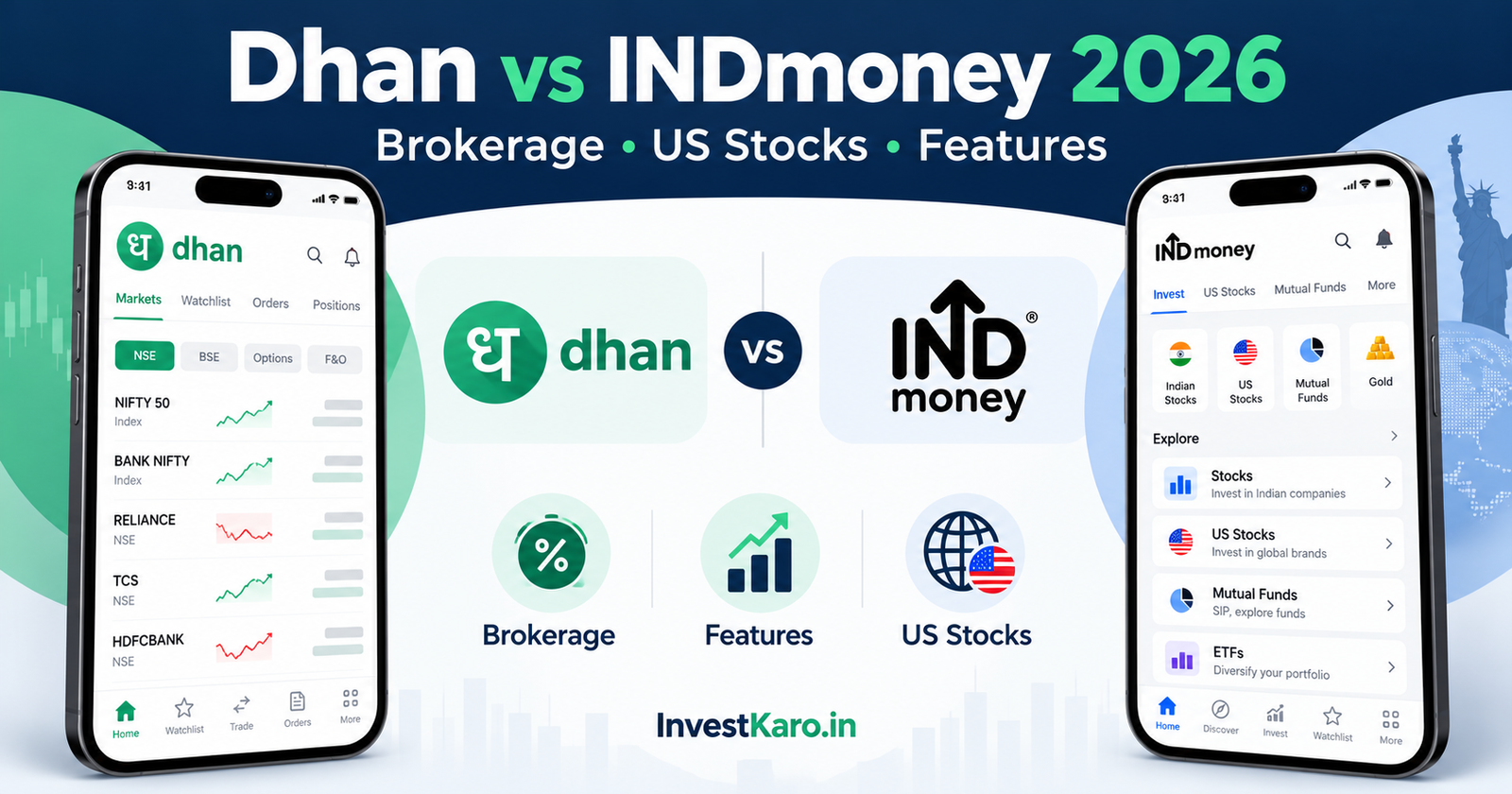
Dhan vs INDmoney is an interesting comparison because both platforms allow Indian investors to access stocks, mutual funds, and US investments, but they approach investing differently.
Dhan focuses heavily on trading tools, advanced charts, and efficient execution. INDmoney combines investing with portfolio tracking and broader personal finance features.
If you are opening a demat account, the difference is not just about which app looks better. Brokerage charges, DP fees, investment products, and your trading habits can make one platform more suitable than the other.
The Dhan vs INDmoney comparison becomes particularly important when you consider how frequently you trade, which financial products you use, and whether you invest only in Indian markets or also in US stocks. Although both platforms offer multiple investment options, their charges and overall experience differ.
In this comparison, we’ll examine the costs, features, limitations, and practical situations where each platform makes sense.
Quick verdict: Dhan has an advantage for cost-conscious Indian equity delivery investors and active traders. INDmoney may appeal more to investors who want Indian stocks, US stocks, mutual funds, and personal finance information accessible from a single application.
Neither platform is automatically the better choice for everyone.
Delta Exchange vs CoinDCX: Which Is Better in 2026?
Dhan vs INDmoney: Quick Comparison
| Feature | Dhan | INDmoney |
|---|---|---|
| Account opening | Free | Free |
| Demat AMC | ₹0 for individuals | ₹0 |
| Equity delivery brokerage | ₹0 | 0.1% or ₹20, whichever is lower; minimum ₹2 |
| Equity intraday brokerage | 0.03% or ₹20, whichever is lower | 0.1% or ₹20, whichever is lower; minimum ₹2 |
| Futures and options | ₹20 per executed order | ₹20 per executed order |
| Delivery sell DP charges | ₹12.50 + GST | ₹18.50 + GST |
| Indian stocks and ETFs | Yes | Yes |
| Direct mutual funds | Yes | Yes |
| US stocks and ETFs | Yes | Yes |
| Advanced options trading tools | Major focus | Available |
| Portfolio aggregation | Investment and trading focused | Broader financial dashboard |
| TradingView integration | Major feature | Feature availability varies |
| Fixed deposits | Not a core product | Available |
| NPS | Not a core product | Available |
Charges reflect publicly listed standard pricing checked in October 2026. Statutory levies, transaction charges, specialised product fees, and account-specific terms may apply.
1. What Is Dhan?
Dhan is an Indian stockbroking and investing platform operated by Raise Securities Private Limited.
The platform is known for emphasizing technology, trading workflows, charts, order execution, and tools designed for active market participants.
Its major offerings include Indian equity investing, futures and options, exchange-traded funds, mutual funds, IPOs, margin trading, and US stocks.
Dhan also provides specialised tools such as Options Trader, TradingView integration, and DhanHQ APIs.
What makes Dhan interesting is that it combines zero brokerage on equity delivery with advanced trading functionality.
This can be useful for investors who buy stocks for the long term but also want access to more sophisticated tools as their market experience grows.
For a detailed discussion of the platform, read our Dhan App Review.
2. What Is INDmoney?
INDmoney is an Indian investing and personal finance platform that brings multiple financial products into one application.
Its services include Indian stock investing, US stocks, direct mutual funds, ETFs, fixed deposits, and financial account aggregation.
The platform’s emphasis is different from Dhan’s.
Rather than focusing primarily on trading execution, INDmoney aims to provide a consolidated view of a user’s investments and broader financial position.
For example, someone who holds mutual funds, Indian shares, US investments, and deposits may find a combined financial dashboard particularly useful.
INDmoney also provides US-investment-related reporting features that can help investors organise transaction and tax information.
You can explore the individual platform in our INDmoney Review.
3. Dhan vs INDmoney Brokerage Charges
Brokerage is one of the most important differences between these platforms.
When comparing Dhan vs INDmoney brokerage charges, the biggest difference appears in equity delivery and smaller intraday trades. Investors should calculate brokerage alongside DP charges, GST, and other applicable transaction costs instead of focusing exclusively on advertised brokerage rates.
However, looking only at the advertised brokerage rate does not give you the complete cost of a trade.
Equity Delivery Brokerage
Dhan currently lists zero brokerage for equity delivery trades.
INDmoney lists equity brokerage at 0.1% of trade value or ₹20 per executed order, whichever is lower, with a minimum charge of ₹2.
Consider an investor purchasing ₹50,000 worth of shares in one order.
On Dhan, the equity delivery brokerage is ₹0.
On INDmoney, the brokerage reaches the ₹20 per-order cap.
If the investor later sells the entire holding through one executed order, another brokerage charge may apply on INDmoney.
That creates a brokerage difference before DP charges and statutory costs are considered.
Equity Intraday Brokerage
For intraday equity trading, Dhan publishes a brokerage of 0.03% of trade value or ₹20 per executed order, whichever is lower.
INDmoney publishes 0.1% of trade value or ₹20 per executed order, whichever is lower, subject to a ₹2 minimum.
For a ₹10,000 intraday order:
- Dhan brokerage: ₹3
- INDmoney brokerage: ₹10
For a ₹1 lakh order, both reach their ₹20 per-order caps.
This matters because traders placing smaller orders may experience a greater difference in brokerage costs than those regularly placing larger orders.
Futures and Options Charges
Both platforms publish standard futures and options brokerage of ₹20 per executed order.
Therefore, choosing between the two for F&O trading involves more than brokerage.
Order types, charting facilities, execution workflows, options analysis, margin requirements, and risk management tools can be equally important.
For active options traders, Dhan’s specialised features are a relevant advantage worth evaluating.
4. Dhan vs INDmoney DP Charges
One cost that investors sometimes overlook is the Depository Participant (DP) charge.
DP charges generally apply when shares are debited from a demat account during delivery sales.
Dhan currently lists ₹12.50 plus GST per instruction/ISIN.
INDmoney lists ₹18.50 plus GST per ISIN for delivery sales.
| Platform | DP charge | Including 18% GST |
|---|---|---|
| Dhan | ₹12.50 | ₹14.75 |
| INDmoney | ₹18.50 | ₹21.83 |
The difference is ₹7.08 for one applicable DP debit.
Although this may appear small, DP charges become relevant for investors frequently selling holdings across multiple securities.
Remember that DP charges are different from brokerage.
A platform offering zero delivery brokerage can still impose DP charges when shares are sold.
5. Real Cost Example: Buying and Selling ₹50,000 Worth of Shares
Let’s assume an investor purchases shares for ₹50,000, holds them in delivery, and later sells the same shares for ₹50,000.
For simplicity, assume one executed buy order, one executed sell order, and one applicable ISIN debit.
| Cost component | Dhan | INDmoney |
|---|---|---|
| Buying brokerage | ₹0 | ₹20 |
| Selling brokerage | ₹0 | ₹20 |
| DP charge | ₹12.50 | ₹18.50 |
| GST on brokerage and DP | ₹2.25 | ₹10.53 |
| Subtotal | ₹14.75 | ₹69.03 |
Difference: ₹54.28 in this example.
These are illustrative brokerage and DP-related subtotals, not complete contract-note charges.
They exclude STT, stamp duty, exchange transaction charges, SEBI fees, and applicable GST on other taxable charges.
Actual costs may change with order execution, transaction value, exchange, and applicable tariff.
The lesson is straightforward: an investor should calculate the total cost of buying and selling, not just compare the headline brokerage rate.
6. Dhan vs INDmoney for US Stocks
Both Dhan and INDmoney now provide ways for eligible Indian investors to access US stocks and ETFs.
For international investors, the Dhan vs INDmoney decision depends on more than US stock brokerage. Currency conversion, funding charges, supported securities, withdrawal conditions, and reporting features can influence the overall experience and investment costs.
This makes the comparison more competitive than simply saying INDmoney offers international investing while Dhan does not.
US Stock Brokerage
Both platforms publish a US stock brokerage rate of 0.25% per trade.
However, total investing costs also depend on currency conversion, remittance fees, funding charges, and the applicable service arrangements.
Dhan US Stocks
Dhan provides access to US stocks and ETFs through its international investing offering.
Its published funding information includes:
- A $1 platform fee for transfers below $100.
- No platform fee for transfers above $100.
- An FX markup shown before confirming conversion.
- Possible bank wire or remittance charges.
That means an investor making a small transfer should consider more than the brokerage charged on a stock purchase.
INDmoney US Stocks
INDmoney offers US stocks and ETFs with fractional investing facilities.
Its public pricing lists:
- Zero US stock account-opening fee.
- Zero annual maintenance charge.
- Zero platform fee.
- Zero withdrawal fee.
- Brokerage of 0.25% per trade.
- Bank forex conversion charges published in a range of 0.5% to 1.2%.
INDmoney also offers reporting features related to US investments and taxation.
Which Is Better for US Stock Investing?
There is no reliable answer without considering transaction size and funding costs.
For example, a person investing $50 at a time should examine minimum transfer fees and currency-conversion costs carefully.
Someone regularly investing larger amounts should compare effective forex rates, brokerage, transaction charges, and withdrawal arrangements.
Both platforms should be evaluated using their current official fee schedules rather than assuming a zero platform fee means investing is completely free.
US investments also involve currency risk, taxation, market risk, and applicable remittance rules.
7. Trading Experience and Platform Features
This is where the underlying design philosophy of both applications becomes clearer.
The Dhan vs INDmoney comparison also highlights how differently the two platforms approach investing. Dhan emphasizes market analysis and trading execution, whereas INDmoney combines investment access with broader portfolio management capabilities.
Dhan: Trading-Focused Tools
Dhan’s trading ecosystem includes advanced charting functionality, options-related tools, TradingView integration, and API access.
These features can be particularly relevant for traders who actively monitor prices, evaluate derivatives, or build automated workflows.
For example, a trader who spends considerable time studying option chains may place more importance on trading interfaces than on consolidated personal finance dashboards.
However, advanced tools do not automatically make trading easier or more profitable. They still require knowledge and effective risk management.
INDmoney: Financial Portfolio Management
INDmoney focuses on providing access to multiple investment products and helping users understand their broader financial picture.
For someone who invests in mutual funds, Indian equities, US stocks, and other financial instruments, a consolidated dashboard can reduce the inconvenience of switching between multiple applications.
This is especially useful for long-term investors who periodically review their investments rather than monitor charts throughout the trading session.
The difference is therefore not simply advanced versus basic.
Dhan emphasizes trading workflows, while INDmoney emphasizes broader investment management.
8. Dhan vs INDmoney for Mutual Funds
Both platforms provide access to direct mutual fund investment options.
Direct mutual funds generally have lower expense ratios than the regular plans of the same schemes because distributor commissions are not built into the same way.
In the Dhan vs INDmoney mutual fund comparison, neither platform should be selected solely because it offers direct mutual fund schemes. Investors should also consider SIP management, portfolio tracking, transaction convenience, and the availability of their preferred schemes.
However, the expense ratio depends on the fund and plan, not simply on whether you use Dhan or INDmoney.
When deciding which platform to use for mutual funds, consider:
- Availability of the required direct schemes.
- SIP setup and modification options.
- Portfolio visibility.
- Statement and reporting features.
- Investment tracking and account convenience.
- Ease of managing multiple asset classes.
For investors primarily focused on mutual funds, the choice may depend more on usability than headline brokerage charges.
You should also remember that holding mutual fund investments across different platforms does not change the underlying market risks of those schemes.
9. Is Dhan or INDmoney Safer?
Both platforms offer Indian securities-market services through regulated entities.
Before opening an account, investors should verify the relevant broker registration, depository arrangements, and current product-specific terms.
It is also important to understand that broker regulation does not remove investment risk.
For example, purchasing a stock through a registered broker does not protect its market price from falling.
Similarly, US stock investment arrangements can involve overseas intermediaries, custody structures, and regulatory protections that differ from Indian demat holdings.
An investor should distinguish between intermediary safeguards, account security, and the risks of the financial product itself.
Never treat the words “regulated” or “registered” as a guarantee of financial returns.
10. Dhan vs INDmoney: Pros and Cons
Dhan Advantages
- Zero brokerage on Indian equity delivery.
- Lower published DP charges in the standard comparison.
- Competitive intraday brokerage for smaller orders.
- Strong emphasis on charts and trading tools.
- Dedicated options trading functionality.
- US stock investing availability.
Dhan Limitations
- Advanced trading features may be unnecessary for occasional investors.
- DP and statutory charges still apply.
- Margin trading and leveraged products involve additional costs and risks.
- US investing has separate funding and currency-conversion considerations.
INDmoney Advantages
- Indian and US investing through one platform ecosystem.
- Broad personal finance and portfolio-tracking functionality.
- Direct mutual funds and other financial products.
- Fractional US stock investing.
- US investment reporting and related tax tools.
- Zero published demat AMC for standard accounts.
INDmoney Limitations
- Indian equity delivery brokerage is not zero under its standard tariff.
- Higher published DP charges than Dhan.
- US investing involves forex and applicable brokerage costs.
- A broad financial dashboard may be unnecessary for dedicated traders.
- Product features and third-party integrations can vary.
11. Dhan vs INDmoney: Which Should You Choose?
Instead of choosing one overall winner, consider what you primarily want from the application.
| Investor profile | Platform worth considering |
|---|---|
| Long-term Indian stock investor focused on brokerage | Dhan |
| Intraday trader placing smaller orders | Dhan |
| Active options trader | Dhan |
| Investor managing different financial assets | INDmoney |
| Investor prioritising consolidated portfolio tracking | INDmoney |
| US stock investor | Compare total FX and brokerage costs |
| Direct mutual fund investor | Both |
| Beginner opening a first demat account | Depends on investment goals and usability |
If you mainly buy Indian stocks and hold them for the long term, Dhan’s zero delivery brokerage is a meaningful advantage.
If you want one application to organise investments and other financial information, INDmoney’s consolidated approach may be more useful.
If you trade frequently, evaluate the full workflow rather than choosing based only on account-opening fees.
And if you primarily invest in US stocks, calculate the total cost of transferring, converting, investing, and withdrawing funds.
12. Dhan Referral Code and Signup Link
If Dhan matches your investing requirements, you can use the following referral details when opening an account.
Dhan Referral Code: DHAN30
Open Dhan Account Using Referral Link
Follow the account-opening process and enter the referral code if requested.
Dhan’s standard pricing already provides zero equity-delivery brokerage and zero AMC for eligible individual accounts. Any additional referral benefits depend on the current programme conditions.
You can also read our Dhan App Review before deciding.
13. INDmoney Referral Code and Signup Link
If you prefer INDmoney’s investment management features, you can use these referral details.
INDmoney Referral Code: DEE60MQPIND
Open INDmoney Account Using Referral Link
Open the referral link and follow the applicable registration and verification process.
If a referral-code field appears, enter DEE60MQPIND.
Referral rewards, if offered, depend on INDmoney’s current programme terms and eligibility conditions. The code alone does not guarantee a bonus.
For more information, read our INDmoney Review or INDmoney Referral Code Guide.
14. Final Verdict: Dhan vs INDmoney in 2026
The choice between Dhan and INDmoney ultimately comes down to how you invest.
Dhan is a compelling option for Indian equity investors who care about brokerage costs and for traders who value dedicated charting and options tools.
Ultimately, Dhan vs INDmoney is not simply a comparison of two mobile applications. It is a comparison of investment priorities.
A frequent trader may value brokerage and advanced trading tools, while a long-term investor may prioritize portfolio visibility and convenient access to multiple financial products.
INDmoney is attractive for investors who want access to several financial products and prefer a consolidated view of their finances.
Neither platform guarantees better investment returns.
A more sophisticated trading interface cannot replace sound investment decisions, and a convenient dashboard does not make a financial product less risky.
Before opening an account, compare the current charges, supported products, applicable terms, and the features you actually expect to use.
The right platform is the one that fits your financial activity—not simply the one with the longest feature list.
Frequently Asked Questions About Dhan vs INDmoney
1. Dhan vs INDmoney: Which is better in 2026?
Dhan may be preferable for cost-conscious Indian stock investors and active traders, while INDmoney may better suit users who want investment products and financial tracking within one application.
2. Is Dhan cheaper than INDmoney?
For standard Indian equity delivery trades, Dhan currently has zero brokerage while INDmoney charges brokerage under its published tariff. Dhan also lists lower DP charges. Other costs depend on the type of transaction.
3. Is Dhan or INDmoney better for beginners?
Both can be considered by beginners. The better choice depends on whether the user mainly wants to invest in stocks, buy mutual funds, trade actively, or manage multiple financial accounts.
4. Does Dhan support US stocks?
Yes. Dhan provides US stock and ETF investing through its international investing offering. Applicable brokerage, currency conversion, and transfer fees should be checked before funding an account.
5. Can I invest in US stocks using INDmoney?
Yes. INDmoney provides US stock and ETF investing, including fractional investing, subject to relevant eligibility and regulatory requirements.
6. What are the DP charges on Dhan and INDmoney?
Dhan lists ₹12.50 plus GST per instruction/ISIN, while INDmoney lists ₹18.50 plus GST per ISIN for delivery sale debits under their published standard tariffs.
7. Which app is better for options trading?
Dhan offers specialised tools focused on options traders, making it worth evaluating for active derivatives trading. Suitability still depends on trading experience, risk management, and the required features.
8. What is the Dhan referral code?
The referral code is DHAN30. Eligible users can sign up through https://invite.dhan.co/?join=DHAN30.
9. What is the INDmoney referral code?
The referral code is DEE60MQPIND. The referral signup link is https://indmoney.onelink.me/RmHC/ktee63qm.
10. Can I have both Dhan and INDmoney accounts?
Generally, eligible investors can maintain trading and demat relationships with multiple brokers, subject to applicable KYC and account requirements. However, multiple accounts may create additional reporting and management responsibilities.
Disclaimer: This article is for educational purposes and does not constitute personalised financial advice. Brokerage and product charges may change. Trading and investing involve financial risk. Verify current terms with the respective platforms before making decisions.