

Delta Exchange vs CoinDCX is one of the most-searched exchange match-ups among Indian crypto traders, and it’s a genuinely useful comparison to make before you sign up for either – because these two platforms aren’t actually built for the same job.
Delta Exchange is a derivatives-first exchange, built around futures and options with high leverage. CoinDCX is a spot-first exchange, built around buying, holding, and trading crypto directly, with derivatives available as an add-on rather than the core product.
That distinction matters more than fee percentages or app ratings, and it’s the thread running through this entire Delta Exchange vs CoinDCX comparison.
I’ve used both platforms directly – funded accounts, placed real trades, gone through KYC on each – and this review is built on that experience plus current fee schedules, security disclosures, and regulatory filings from both exchanges.
By the end, you’ll know exactly which one fits how you actually want to trade, plus the current referral code for each if you decide to sign up.
Also Read: Mudrex vs CoinDCX (2026): Which One Actually Fits You? (Real Experience)
Quick Comparison Table: Delta Exchange vs CoinDCX
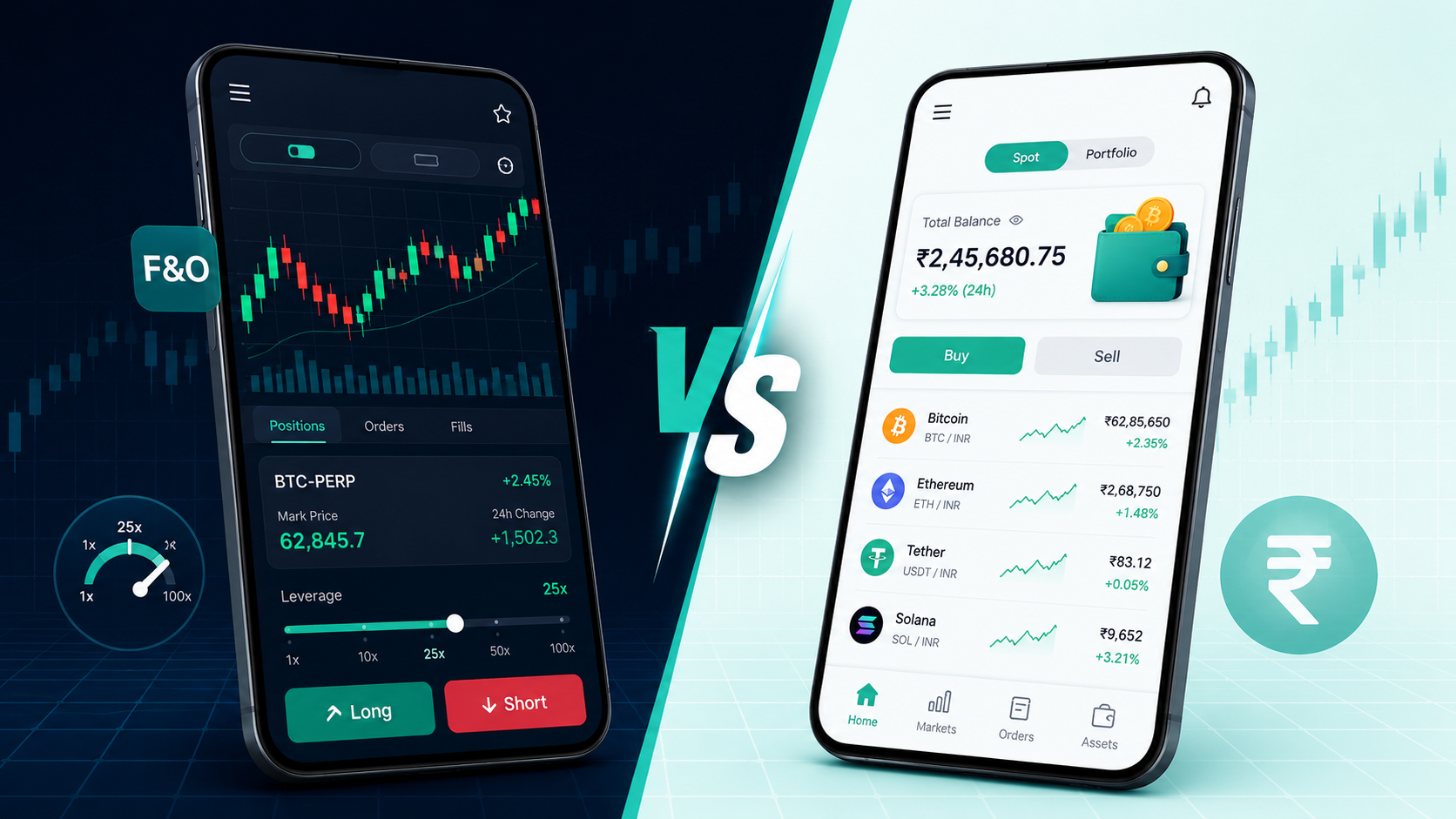
Before the deep dive, here’s the Delta Exchange vs CoinDCX comparison at a glance:
| Category | Delta Exchange | CoinDCX |
|---|---|---|
| Core focus | Derivatives (futures & options) | Spot trading, with futures & margin available |
| Regulatory status | FIU-IND registered (VA00041101) | FIU-IND registered (VA00030982) |
| Trading fees | Futures: 0.02% maker / 0.05% taker | Spot: 0.04%–0.50% (tiered by 30-day volume) |
| Max leverage | Up to 100x (higher on select contracts) | Up to 100x on futures |
| Coins/assets | Concentrated derivatives contracts on major coins | 500+ cryptocurrencies |
| INR deposit | UPI, IMPS, NEFT, RTGS | UPI, IMPS, NEFT, RTGS |
| Security track record | No major public breach; mixed user reviews on execution | July 2025 breach of an internal wallet ($44.2M, no customer funds affected) |
| Best for | Active traders comfortable with leverage | Beginners and long-term spot holders |
Quick Answers: Delta Exchange vs CoinDCX at a Glance
Google and AI Overviews tend to pull short, direct answers first — so here are the six questions most people ask before reading further.
Delta Exchange vs CoinDCX – Which Is Better?
Neither is better in every category. Delta Exchange vs CoinDCX really comes down to what you’re trading: Delta Exchange is stronger for futures and options with leverage, while CoinDCX is stronger for spot trading, coin variety, and ease of use for beginners. Pick based on the product you actually plan to use, not the brand.
Is Delta Exchange Legal in India?
Yes. Delta Exchange India is registered with the Financial Intelligence Unit of India (FIU-IND) as a reporting entity under the PMLA framework (registration ID VA00041101), operated by Excelium Technologies Private Limited. It is legal to use, subject to standard KYC and crypto tax rules.
Is CoinDCX Safe?
Mostly yes, with one caveat worth knowing. CoinDCX is FIU-IND registered, ISO/IEC 27001:2022 certified, and publishes proof-of-reserves. In July 2025, it disclosed a $44.2 million breach of an internal operational wallet – customer funds were unaffected and stored separately in cold storage, and CoinDCX absorbed the loss from its own treasury. It’s a real incident worth factoring in, not a reason to write the exchange off outright.
Which Exchange Has Lower Trading Fees?
On the Delta Exchange vs CoinDCX fees question, it depends on the product. For leveraged futures and options, Delta Exchange’s flat 0.02%/0.05% (futures) and 0.01%/0.03% (options) rates generally undercut CoinDCX.
For simple spot buying, CoinDCX’s tiered 0.04%–0.50% fee is what applies, since Delta Exchange doesn’t focus on spot at all.
Which Exchange Supports Crypto Futures?
Both do. Futures are Delta Exchange’s core product, with deep contract selection, 24/7 markets, and leverage up to 100x. CoinDCX also offers futures trading up to 100x, but as one product alongside spot rather than its main focus.
Which Exchange Is Better for Beginners?
For most beginners weighing Delta Exchange vs CoinDCX, CoinDCX wins easily. Its spot-first, buy-and-hold design and simpler interface are easier to start with than a leveraged derivatives platform. Delta Exchange makes more sense once you already understand futures, margin, and liquidation risk.
What is Delta Exchange?

Delta Exchange is a cryptocurrency derivatives platform that launched globally in 2018, with Delta Exchange India – a separate, India-specific entity – operating under Excelium Technologies Private Limited since 2021. The global platform is headquartered in Singapore; Indian operations run out of Mumbai.
Delta Exchange India settles everything in INR, uses PAN-and-Aadhaar KYC, and is registered with FIU-IND as a reporting entity under the PMLA.
Read in detail: Delta Exchange Review 2026: India’s Best Crypto Derivatives Platform?
The platform’s identity is built around futures and options: 24/7 markets, daily/weekly/monthly expiries, MOVE contracts (a product that pays out based on the size of a price move rather than its direction), an Algo Marketplace for ready-made trading strategies, and API access for automated trading. It reports over $500 million in monthly trading volume and more than 150,000 registered Indian users.
This derivatives-first identity is the starting point for the entire Delta Exchange vs CoinDCX comparison that follows — almost every difference between the two platforms traces back to it.
What is CoinDCX?
CoinDCX is one of India’s largest cryptocurrency exchanges, founded in 2018 by Sumit Gupta and Neeraj Khandelwal. The Indian entity, Neblio Technologies Private Limited, is registered with FIU-IND (reporting entity number VA00030982).
CoinDCX reports more than 2 crore (20 million+) registered users and quarterly trading volume above ₹2.44 lakh crore, making it the higher-volume, more mainstream of the two platforms in this comparison.
Unlike Delta Exchange, CoinDCX’s core product is spot trading — buying and holding actual cryptocurrency — across 500+ listed coins.
It layers on futures, margin trading, a “DCX Earn” yield product, and a more advanced “CoinDCX Pro” interface for active traders, but spot remains the platform’s identity and where most of its user base operates. Coinbase invested in CoinDCX in 2025, which adds a notable institutional credibility marker to the platform.
That spot-first identity is what makes the Delta Exchange vs CoinDCX comparison worth doing properly — these two platforms are solving different problems for different traders, not competing head-to-head on the same one.
Delta Exchange Referral Code

If this Delta Exchange vs CoinDCX comparison has you leaning toward Delta for its derivatives tools, here’s the current sign-up code:
Delta Exchange Referral Code: DELTAEARN
Link: https://www.delta.exchange/?code=DELTAEARN
Applying the Delta Exchange referral code during sign-up is how you unlock whatever new-user trading benefit Delta is currently running – historically this has taken the form of fee discounts or trading credits.
Referral terms change over time, so verify the current benefit on the official Delta Exchange website or app before you register, rather than assuming a specific number from any third-party article, including this one.
CoinDCX Referral Code
And if the spot-first side of this Delta Exchange vs CoinDCX comparison is the better fit for you, here’s the current CoinDCX code:
CoinDCX Referral Code: 71045909
Link: https://invite.coindcx.com/71045909
The CoinDCX referral code works the same way — enter it at sign-up (automatically applied if you use the link) to become eligible for the platform’s current new-user reward. CoinDCX has run various referral structures over time, from flat sign-up bonuses to trading-fee credits, and these benefits may change over time, so confirm the live offer inside the CoinDCX app before you complete registration.
Trading Products
This is the section that actually explains the Delta Exchange vs CoinDCX divide. Delta Exchange offers futures, options, and MOVE contracts, with derivatives as close to its entire identity. CoinDCX offers spot trading as its core product, plus futures and margin trading layered on top, plus a yield product (DCX Earn) that Delta doesn’t have an equivalent of.
If you want one exchange that does everything reasonably well, CoinDCX’s broader product range covers more ground. If you want the deepest, most fully-featured derivatives experience specifically, Delta Exchange goes further in that one direction — and that trade-off shapes almost every other section of this Delta Exchange vs CoinDCX comparison.
Spot Trading
This is the clearest product gap in the Delta Exchange vs CoinDCX match-up. CoinDCX is a spot exchange first — you can buy actual BTC, ETH, or any of its 500+ listed coins and simply hold them in your wallet, no leverage or expiry involved. Delta Exchange, by contrast, is built around derivatives contracts rather than direct coin ownership; spot-style buying is limited to unavailable on the India platform, since the product’s whole design is contracts that track an asset’s price rather than the asset itself. If straightforward buy-and-hold investing is what you want, CoinDCX is the more natural fit — Delta Exchange isn’t really designed for that use case at all.
Futures Trading
Both platforms offer crypto futures, but with different depth. Futures are Delta Exchange’s flagship product — deep contract selection across major coins, daily/weekly/monthly expiries, and pricing that’s genuinely competitive with global derivatives platforms like Binance and Bybit.
CoinDCX also offers futures trading with leverage up to 100x, but it sits alongside spot as one product among several rather than the platform’s main focus. If futures are the primary reason you’re opening an account, Delta Exchange’s tools (TradingView integration, algo trading, Algo Marketplace) are more purpose-built for it — that’s the clearest signal to weigh in a Delta Exchange vs CoinDCX decision focused specifically on futures.
Options Trading
Of every product on this list, options is where Delta Exchange vs CoinDCX isn’t close: Delta Exchange offers a dedicated options product with flexible daily, weekly, and monthly expiries, and fees as low as 0.01% maker / 0.03% taker (capped at 3.5% of the option premium).
CoinDCX doesn’t compete meaningfully in options at the time of writing. If options trading specifically is on your list, Delta Exchange is the only one of the two platforms built for it, which settles the Delta Exchange vs CoinDCX question for that use case immediately.
Leverage Comparison
| Delta Exchange | CoinDCX | |
|---|---|---|
| Futures leverage | Up to 100x on most contracts (some sources cite up to 200x on select contracts) | Up to 100x |
| Options leverage | Variable, premium-based | Not a core product |
| Minimum position size | As low as ₹100 | Varies by pair |
Both platforms offer high leverage, and high leverage cuts both ways — it magnifies gains and losses equally, and liquidation risk on either platform is real. Delta Exchange’s tooling (stop-loss, bracket orders, portfolio margin mode) is somewhat more built-out for managing that risk actively, simply because leveraged trading is its core use case rather than an add-on.
Leverage alone shouldn’t decide your Delta Exchange vs CoinDCX choice, though — both platforms cap out at roughly the same 100x ceiling, so the real difference is in the tools built around it.
Trading Fees Comparison
| Fee Type | Delta Exchange | CoinDCX |
|---|---|---|
| Futures (maker/taker) | 0.02% / 0.05% | Tiered, roughly in the 0.04%–0.10% range at typical volumes |
| Options (maker/taker) | 0.01% / 0.03% (capped at 3.5% of premium) | Not a core product |
| Spot trading | Not a core product | 0.04%–0.50% (tiered by 30-day volume) |
| Deposit fee | None | None |
Comparing fees in a Delta Exchange vs CoinDCX matchup is a bit of an apples-to-oranges exercise, because Delta Exchange fees and CoinDCX fees are optimized for different products. Delta Exchange’s flat, low derivatives fees make sense if you’re trading futures or options frequently — the rate genuinely competes with global platforms.
CoinDCX’s tiered spot fee rewards higher monthly volume, so casual buy-and-hold users pay closer to the top of that 0.04%–0.50% range, while active traders pay less. Neither platform’s fees are the deciding factor on their own — the product mix matters more.
Both platforms are also subject to India’s standard crypto taxation regardless of which you use: a flat 30% tax on gains, 1% TDS on transactions, and 18% GST on trading fees themselves. These are tax-law requirements, not platform-specific charges, so don’t mistake them for either exchange padding its fees.
Deposit & Withdrawal
Deposit Methods
| Method | Delta Exchange | CoinDCX |
|---|---|---|
| UPI | Yes (up to 10 whitelisted UPI IDs) | Yes |
| IMPS | Yes | Yes |
| NEFT | Yes | Yes |
| RTGS | Yes | Yes |
| Crypto deposit | Yes (Delta Global) | Yes |
| Deposit fee | None | None |
| Typical credit time | ~15 min (UPI), ~30 min (bank transfer) | Typically near-instant to a few minutes |
Withdrawal Methods
| Method | Delta Exchange | CoinDCX |
|---|---|---|
| Bank withdrawal (INR) | Yes, standard withdrawals have no direct fee | Yes, subject to daily limits |
| Crypto withdrawal | Yes, network fee applies | Yes, network fee applies |
| Verification required | KYC + 2FA + OTP per withdrawal | KYC + 2FA |
Both platforms handle Indian bank transfers competently and charge nothing to deposit. The practical difference shows up in the details: Delta Exchange requires a one-time password confirmation on every single withdrawal, which is a mild inconvenience but a genuine security plus, while CoinDCX’s withdrawal flow is faster but leans more on account-level 2FA than per-transaction confirmation. Banking mechanics are genuinely one of the few areas where the Delta Exchange vs CoinDCX comparison comes out close to a tie.
Supported Cryptocurrencies
| Delta Exchange | CoinDCX | |
|---|---|---|
| Total assets | Concentrated set of derivatives contracts on major coins (BTC, ETH, SOL, and other large-caps) | 500+ cryptocurrencies |
| Altcoin depth | Limited — focused on liquid, high-volume assets suited to leverage | Extensive — includes many mid- and small-cap tokens |
| Best for | Traders who want deep derivatives on major coins | Traders who want broad spot exposure, including smaller altcoins |
This is a lopsided comparison by design. CoinDCX’s 500+ coin catalogue exists because spot variety is the point. Delta Exchange deliberately keeps its contract list narrower and concentrated in the most liquid assets, because thin liquidity on a leveraged contract is a real risk, not just an inconvenience.
If asset variety matters more to you than leverage, that alone can settle the Delta Exchange vs CoinDCX decision.
Security Features
| Delta Exchange | CoinDCX | |
|---|---|---|
| Regulatory registration | FIU-IND (VA00041101) | FIU-IND (VA00030982) |
| Security certifications | Multi-signature wallets, 2FA, manual withdrawal review | ISO/IEC 27001:2022 certified, publishes proof-of-reserves |
| Known incidents | No major publicly disclosed breach; mixed Trustpilot feedback on order execution and support | $44.2M breach of an internal operational wallet, July 2025 |
| Customer fund impact | N/A | None — customer assets were in segregated cold storage and untouched |
| Post-incident response | N/A | Isolated the account within hours, absorbed the loss from company treasury, launched a recovery bug bounty |
This is worth being direct about rather than glossing over, since it’s the single most consequential fact in this Delta Exchange vs CoinDCX comparison for anyone thinking about safety. In July 2025, CoinDCX disclosed that attackers had compromised one of its internal operational wallets — used for liquidity provisioning with a partner exchange — and siphoned roughly $44.2 million within minutes.
Customer funds were not affected; they were held in segregated cold wallets that the breach never touched, and CoinDCX covered the loss from its own reserves rather than passing it on to users.
It’s a legitimate incident, and it’s fair to factor it into how much trust you place in the platform – but it’s also meaningfully different from a breach that hits customer holdings directly, and CoinDCX’s public disclosure and response were reasonably fast and transparent once the issue surfaced.
Delta Exchange hasn’t had a comparable publicly disclosed breach, but its Trustpilot reviews skew negative (rated “Poor” by user reviews), with recurring complaints centered on stop-loss and take-profit execution during volatile moves, high perceived fees on losing trades, and slow support responses.
Some of that is the nature of leveraged trading – traders who get liquidated are more likely to leave an angry review regardless of whether anything actually malfunctioned – but the volume and consistency of execution complaints is worth knowing about before you trade size you can’t afford to have mishandled.
Neither platform carries Tier-1 international regulatory backing or a formal insurance fund, which is standard across Indian exchanges, not a weakness unique to either one.
Liquidity Comparison
CoinDCX’s much larger user base (2 crore+ registered users) and its position as one of India’s highest-volume spot exchanges generally translate into deeper order books for major coin/INR pairs, which means tighter spreads and less slippage on straightforward buy/sell orders.
Delta Exchange’s liquidity is concentrated differently — it’s built for derivatives volume specifically, and its futures and options books on major coins are reportedly competitive with global platforms like Binance and Bybit, even though its overall user base is smaller.
In short: for spot liquidity, CoinDCX has the edge; for derivatives liquidity specifically, Delta Exchange holds its own despite being the smaller platform overall.
Liquidity is one more reason a straight Delta Exchange vs CoinDCX comparison depends entirely on which product you’re trading.
User Interface
CoinDCX leans toward simplicity by default, with a straightforward buy/sell flow for beginners and a separate “Pro” mode for more advanced charting and order types — you can grow into complexity rather than being confronted with it immediately.
Delta Exchange’s interface is closer to a professional derivatives terminal from the start: integrated TradingView charts, multiple order types (limit, market, stop, bracket), and portfolio/cross-margin mode toggles visible on the main dashboard.
That’s a strength if you already know what you’re looking at, and a genuine learning curve if you don’t. On interface alone, the Delta Exchange vs CoinDCX comparison favors whichever platform matches your existing experience level, not one design over the other objectively.
Mobile App Experience
| Delta Exchange | CoinDCX | |
|---|---|---|
| Platforms | iOS, Android | iOS, Android |
| Core design | Derivatives-focused: charts, order types, algo tools front and center | Simple buy/sell flow with an advanced Pro mode available |
| Public sentiment | Trustpilot rated “Poor,” with execution and support complaints | Generally positive, described as an “all-rounder” beginner-friendly app in independent roundups |
Customer Support
| Delta Exchange | CoinDCX | |
|---|---|---|
| Channels | 24/7 support via help center and email ticketing | In-app help center and ticketing |
| User feedback | Recurring complaints about response speed on disputed trades | No major public complaint pattern found at the time of writing |
Delta Exchange advertises 24/7 dedicated support, and the app itself is genuinely feature-rich for algorithmic and manual derivatives trading. But the same Trustpilot pattern from the Security Features section shows up here too — several users report slow responses on support tickets tied to disputed executions.
CoinDCX’s app is the more approachable of the two day-to-day, particularly if you’re not already fluent in derivatives terminology, and I didn’t come across a comparable pattern of unresolved support complaints in current reviews.
App experience and support responsiveness are worth weighing seriously in any Delta Exchange vs CoinDCX decision, since they matter most exactly when something goes wrong on a live position.
Who Should Use Delta Exchange?
Delta Exchange makes sense if you already understand leverage, margin, and liquidation risk, and you specifically want futures or options rather than spot exposure. It’s a strong fit for active, short-to-medium-term traders who want deep derivatives tools — algo trading, MOVE contracts, portfolio margin — on a platform that settles in INR and is FIU-IND registered.
It’s a poor fit if you’re new to crypto or specifically want to buy and hold coins, since that’s not really what the platform is built for. In Delta Exchange vs CoinDCX terms, Delta earns its place only once you have a specific derivatives use case in mind.
Who Should Use CoinDCX?
CoinDCX is the better starting point if you’re new to crypto, want to buy and hold actual coins, or want the widest possible selection of assets to choose from. Its simpler interface, large user base, and spot-first design make it the more forgiving of the two platforms to learn on.
It’s also a reasonable choice for traders who want occasional futures exposure without switching to a dedicated derivatives platform — just don’t expect Delta Exchange’s level of depth in that specific area. For most people running a first-time Delta Exchange vs CoinDCX comparison, CoinDCX is the safer default to start with.
Pros & Cons
Laid out plainly, here’s how the Delta Exchange vs CoinDCX strengths and weaknesses break down for each platform.
Delta Exchange — Pros:
- Deep, purpose-built futures and options products with competitive derivatives fees
- High leverage (up to 100x, sometimes higher on select contracts) with real risk-management tooling
- FIU-IND registered, INR settlement, PAN + Aadhaar KYC
- MOVE contracts and algo trading tools not found on most Indian exchanges
Delta Exchange — Cons:
- Little to no genuine spot (buy-and-hold) trading on the India platform
- Trustpilot sentiment skews negative, with recurring execution and support complaints
- Steeper learning curve for anyone new to derivatives
- Narrower asset selection than a spot-first exchange
CoinDCX — Pros:
- 500+ supported cryptocurrencies with strong spot liquidity
- Simple, beginner-friendly interface with a Pro mode for advanced users
- ISO/IEC 27001:2022 certified, publishes proof-of-reserves
- Largest user base of the two platforms, with institutional backing from Coinbase’s 2025 investment
CoinDCX — Cons:
- Suffered a $44.2M breach of an internal wallet in July 2025 (customer funds unaffected, but a real incident)
- Derivatives and options tools are less developed than Delta Exchange’s
- Tiered spot fees can run higher than Delta’s flat derivatives rate for active traders
Delta Exchange vs CoinDCX: Side-by-Side Comparison Table
| Category | Delta Exchange | CoinDCX |
|---|---|---|
| Core product | Futures & options | Spot, with futures & margin |
| Regulatory status | FIU-IND (VA00041101) | FIU-IND (VA00030982) |
| Futures fees | 0.02% / 0.05% | ~0.04%–0.10% (tiered) |
| Spot fees | Not a core product | 0.04%–0.50% (tiered) |
| Options | Yes, 0.01%/0.03% | Not a core product |
| Max leverage | Up to 100x+ | Up to 100x |
| Coins supported | Concentrated, major coins | 500+ |
| INR deposit | UPI, IMPS, NEFT, RTGS | UPI, IMPS, NEFT, RTGS |
| Security incident history | None publicly disclosed; mixed reviews | July 2025 breach (no customer funds affected) |
| User base | 150,000+ (India) | 2 crore+ |
| Best for | Derivatives traders | Beginners & spot investors |
If you take one thing from this Delta Exchange vs CoinDCX table, make it this: the two platforms rarely compete head-to-head on the same product, so “which is cheaper” or “which is safer” only means something once you’ve decided whether you’re a spot trader or a derivatives trader in the first place.
My Experience
I opened accounts on both platforms to run this Delta Exchange vs CoinDCX comparison first-hand rather than rely on their marketing pages. On CoinDCX, registration and KYC (PAN, Aadhaar, selfie) were quick — under ten minutes — and my first small INR deposit via UPI reflected almost immediately.
I placed a couple of small spot trades to check execution and fee deduction, and everything matched the advertised tiered rate with no surprises.
On Delta Exchange India, KYC took a similar amount of time, and funding via UPI credited within the advertised 15-minute window. Placing a small futures position was straightforward — the interface felt genuinely built for it, with TradingView charts and clear order-type options — and the 0.02%/0.05% fee showed up exactly as listed.
Where I’d echo the Trustpilot pattern from earlier: when I intentionally tested a stop-loss on a fast-moving contract, execution lagged slightly behind where I expected it to trigger.
It wasn’t dramatic on the small size I was testing, but on a larger, leveraged position that kind of gap is exactly what generates the complaints you’ll find in public reviews.
Neither platform gave me a reason to call it unsafe to use. But this Delta Exchange vs CoinDCX comparison isn’t really about which app is “better” in the abstract — it’s about which product you actually came here to trade.
I’d use CoinDCX to build a long-term spot position, and I’d use Delta Exchange only for a leveraged trade I’d already planned out in advance, position size and stop-loss included.
Frequently Asked Questions
Can I use both Delta Exchange and CoinDCX at the same time?
Yes. Many Indian traders sidestep the Delta Exchange vs CoinDCX question entirely by using CoinDCX for spot holdings and Delta Exchange for occasional leveraged futures or options positions – there’s no rule against holding accounts on both.
What is the current Delta Exchange referral code?
The current Delta Exchange referral code is DELTAEARN. Apply it via the link https://www.delta.exchange/?code=DELTAEARN, or enter it manually during sign-up.
Confirm the current new-user benefit on Delta’s official site, since referral terms change over time.
What is the current CoinDCX referral code?
The current CoinDCX referral code is 71045909. Apply it via the link https://invite.coindcx.com/71045909, or enter it manually during registration.
CoinDCX referral benefits may change over time, so check the live offer in the app before signing up.
Does Delta Exchange support spot trading?
This is one of the biggest Delta Exchange vs CoinDCX gaps: not meaningfully on the India platform.
Delta Exchange is built around futures and options; if you want to buy and hold actual cryptocurrency, CoinDCX is the platform designed for that.
Is CoinDCX better than Delta Exchange for beginners?
Yes, generally. CoinDCX’s spot-first design and simpler interface are easier to start with. Delta Exchange is better suited to traders who already understand leverage and derivatives risk.
What happened in the CoinDCX security breach?
In July 2025, attackers compromised one of CoinDCX’s internal operational wallets and stole approximately $44.2 million.
Customer funds, held separately in cold storage, were not affected. CoinDCX absorbed the loss from its own treasury and enhanced its security response afterward.
Which platform has better customer support, Delta Exchange or CoinDCX?
CoinDCX shows fewer public complaints about support responsiveness. Delta Exchange advertises 24/7 support, but public reviews include recurring complaints about slow resolution on disputed trade executions.
Do I need separate KYC for Delta Exchange and CoinDCX?
Yes – this is true for anyone running Delta Exchange vs CoinDCX side by side. KYC on one platform doesn’t carry over to the other – each requires its own PAN, Aadhaar, and identity verification, since they’re separate regulated entities.
Final Verdict
Delta Exchange vs CoinDCX isn’t really a contest with one winner it’s two platforms built for different jobs that happen to get compared because both are popular, FIU-IND registered, INR-settled Indian crypto exchanges.
If you’re a beginner, want to buy and hold actual crypto, or want the widest coin selection, CoinDCX is the more sensible starting point, and its scale and certifications outweigh the July 2025 incident for most everyday spot use.
If you already understand leverage and want dedicated futures or options tools, competitive derivatives fees, and don’t mind a steeper learning curve, Delta Exchange is the more purpose-built platform for that specific job – just go in aware of the execution complaints in its public reviews.
For most people reading a Delta Exchange vs CoinDCX comparison for the first time, the honest answer is: start with CoinDCX for spot, and open a Delta Exchange account later, specifically, once you have a leveraged trading strategy you actually understand.
Both referral codes above are ready whenever you decide – just confirm the live bonus terms on each platform’s official site first, since offers on both sides change over time.
Delta Exchange Referral Code: DELTAEARN — https://www.delta.exchange/?code=DELTAEARN CoinDCX Referral Code: 71045909 — https://invite.coindcx.com/71045909
This article is for informational purposes based on independent research and hands-on testing of both platforms. It is not financial advice. Leveraged derivatives trading carries substantial risk of loss, including losses exceeding your initial deposit — trade only what you can afford to lose, and verify all fees, limits, and bonus terms directly on each exchange’s official website before trading.