
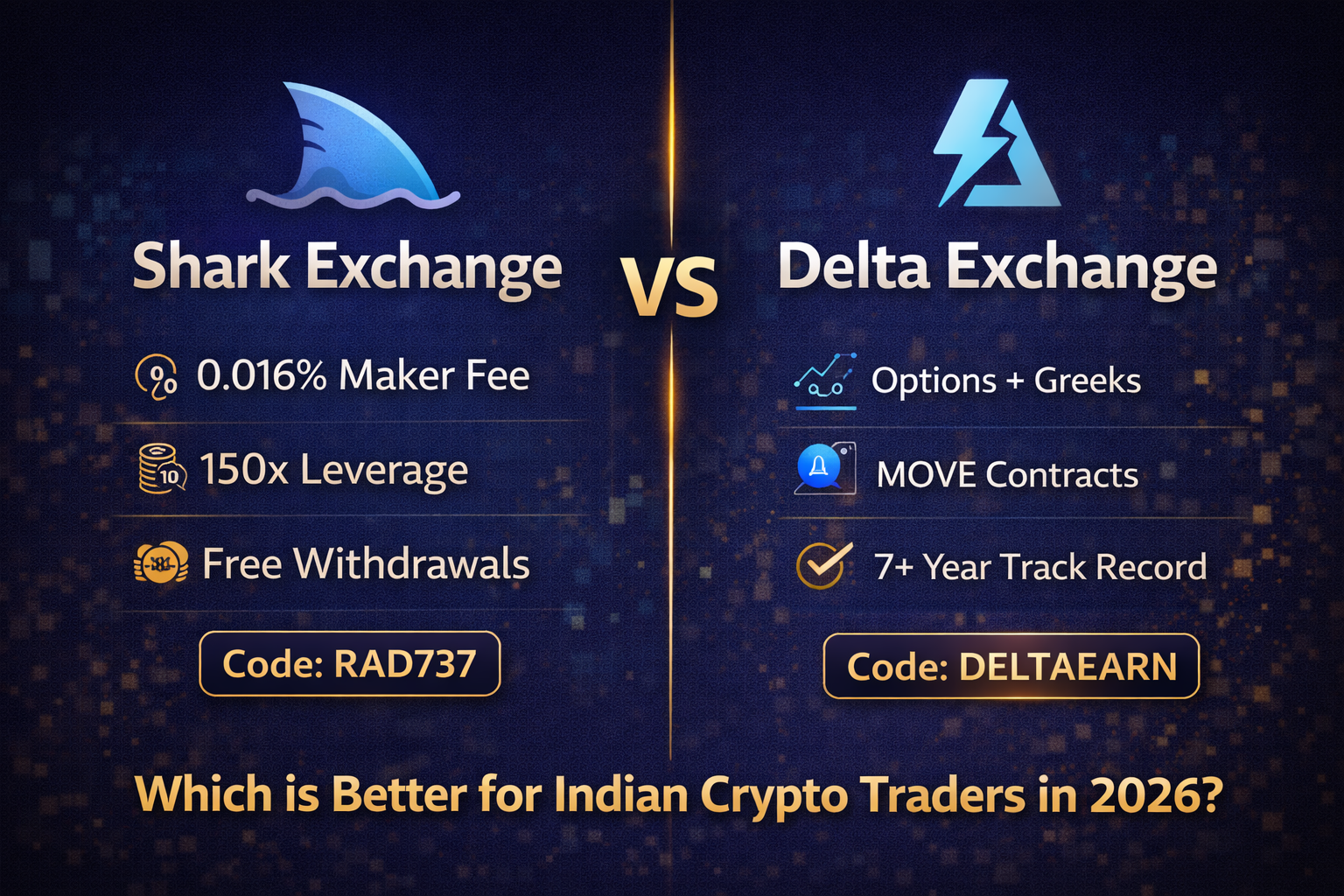
Shark Exchange vs Delta Exchange — if you’ve been trading crypto derivatives in India in 2026, you’ve almost certainly encountered both names.
They occupy the same niche: INR-native crypto futures and options platforms built for Indian traders who want to speculate on cryptocurrency price movements without buying the underlying assets.
But they are not the same platform, and for an active derivatives trader, the differences matter a great deal.
This Shark Exchange vs Delta Exchange article started with a genuine personal dilemma: I was already using Delta Exchange and had heard Shark Exchange was offering significantly lower trading fees.
Quick Sign-Up – Both Apps
Before committing capital to a newer platform, I wanted to do a thorough side-by-side analysis. This article is the result of that research — a direct, honest Shark Exchange vs Delta Exchange comparison covering fees, leverage, available products, security, INR experience, app quality, and referral benefits.
Before we dive in: both platforms have active referral codes worth using. For Shark Exchange, use code RAD737 at sharkexchange.in/referral?code=RAD737
For Delta Exchange, use code DELTAEARN at delta.exchange/?code=DELTAEARN for a 10% trading fee discount for 6 months.
🦈 Shark Exchange Referral Code: RAD737 → sharkexchange.in/referral?code=RAD737 ⚡ Delta Exchange Referral Code: DELTAEARN → delta.exchange/?code=DELTAEARN — 10% off all fees for 6 months
Shark Exchange vs Delta Exchange: Quick Overview
Before going deep into the Shark Exchange vs Delta Exchange comparison, here’s the essential snapshot:
Shark Exchange is a newer Indian crypto derivatives platform operated by Lightningnodes Technologies Private Limited, headquartered in Ahmedabad. It is FIU-registered (REID VA00045558) and focused exclusively on crypto futures and options with INR settlement.
Its core positioning is India’s lowest-cost derivatives exchange — with a maker fee of 0.016% and taker fee of 0.040%, which are among the most competitive fee structures available to Indian crypto derivatives traders anywhere in 2026.
Delta Exchange is a more established crypto derivatives platform — the India instance operated by Excelium Technologies Private Limited, FIU-registered (REID VA00041101), founded in 2018 and serving Indian users since 2021.
Delta has built a strong brand around product depth — perpetual futures, fixed-maturity futures, European-style options, MOVE (volatility) contracts, spread contracts, Robo Strategies, and a testnet environment. Its fees are higher than Shark Exchange but it brings a more mature ecosystem.
The short version of this Shark Exchange vs Delta Exchange comparison: Shark Exchange wins on fees and leverage cap. Delta Exchange wins on product breadth, track record, and advanced trading products.
Read on for the full Shark Exchange vs Delta Exchange breakdown.
Shark Exchange vs Delta Exchange: Company Background & Credibility
Shark Exchange
Shark Exchange is a relatively new entrant in the Indian crypto derivatives space. It is operated by Lightningnodes Technologies Private Limited, registered in India with FIU-IND (REID VA00045558), and headquartered at 13th Floor, Gala Empire, Memnagar, Ahmedabad — a publicly disclosed physical address, which is a positive transparency signal.
Being newer means Shark Exchange has a shorter operational track record. It was still building its community and user base as of early 2026, with a growing Instagram following and an appearance as a Gold Partner at TokenIQ 2026 — a major crypto conference in Bengaluru. The platform is clearly gaining recognition in India’s derivatives trading community.
This Shark Exchange vs Delta Exchange credibility comparison must be honest: as a newer platform, Shark Exchange has not yet been tested through a prolonged bear market, a major liquidity crisis, or an extreme volatility event the way Delta Exchange has.
That’s not a disqualifier — all platforms start somewhere — but it’s a relevant data point for risk-conscious traders deciding where to hold funds.
Delta Exchange
Delta Exchange has been operating since 2018 — over seven years — and the India-focused instance has been running since 2021.
This Shark Exchange vs Delta Exchange contrast in track record is significant: Delta has processed Indian trader activity through multiple market cycles, regulatory changes, and platform evolution.
It has maintained operations without a major security incident or regulatory action.
Delta Exchange India is backed by institutional investors and has grown to serve a substantial user base of Indian derivatives traders.
Its registration at multiple events, its documented participation in the Indian fintech ecosystem, and its consistently updated product offerings (MOVE contracts, Robo Strategies, API access) all indicate a well-resourced, long-term operation.
Shark Exchange vs Delta Exchange: Products & Trading Instruments
This is where the Shark Exchange vs Delta Exchange comparison becomes most practically important for traders deciding which platform to use.
Shark Exchange — Products
Shark Exchange offers:
Perpetual Futures: Trade BTC, ETH, SOL, and other cryptocurrency pairs with no expiry date. Go long or short with up to 150x leverage. Settle directly in INR — no USDT conversion needed. INR deposits via IMPS are instant and free. INR withdrawals are also free and processed to your verified bank account.
Crypto Options: Shark Exchange has added options trading to its product lineup, with a maximum fee cap of 5% of the option premium. This positions Shark Exchange as a full-spectrum derivatives platform, not just a futures exchange.
Isolated Margin Mode: Manage risk per position with isolated margin — your overall account isn’t affected by the liquidation of one position.
Real-time Charts with Advanced Indicators: The trading interface includes advanced charting with technical indicators. One notable gap flagged by users: the mobile app currently does not show P&L on charts, though the web interface does.
Fee Rebate Programme: Shark Exchange runs a Monthly Fee Rebate Program — if you’re profitable for the month, you can earn back trading fees. This is a distinctive feature that directly rewards winning traders.
Delta Exchange — Products
Delta Exchange offers a significantly deeper product catalogue:
Perpetual Futures: BTC, ETH, SOL, XRP, DOGE, and 50+ altcoin pairs. Up to 100x leverage. INR-settled on the India platform.
Fixed Maturity Futures: Daily, weekly, and monthly expiry contracts — allowing traders to express views tied to specific date horizons without perpetual funding rate exposure.
European-Style Options: Call and put options on BTC and ETH with full live Greeks display (Delta, Gamma, Theta, Vega), real-time payoff simulation, daily/weekly/monthly expiries, and deep ITM to deep OTM strikes. This is Delta Exchange’s most significant exclusive product in the Indian market — no other major Indian derivatives platform offers retail crypto options at this sophistication level.
MOVE Contracts: Volatility straddle derivatives that profit when price moves significantly in either direction. Unique to Delta Exchange in the Indian retail derivatives market.
Spread Contracts: Relative value instruments for trading the price difference between two assets.
Robo Strategies: Pre-built algorithmic trading strategies including Top 20 Momentum and Large Cap AMM, allowing non-technical traders to deploy automated approaches.
Testnet / Demo Account: Practice with real market data and zero financial risk before going live.
Free API (DhanHQ): Full REST and WebSocket API access for algorithmic traders, with sub-50ms order latency.
The Shark Exchange vs Delta Exchange Product Verdict
If you trade perpetual futures exclusively, Shark Exchange and Delta Exchange both serve this use case — with Shark Exchange offering lower fees and higher leverage (150x vs 100x).
If you want options trading, MOVE contracts, spread contracts, Robo Strategies, or a testnet, Delta Exchange is the only choice. These products simply don’t exist on Shark Exchange at comparable depth.
Shark Exchange vs Delta Exchange: Fees — The Most Important Comparison
This is the heart of the Shark Exchange vs Delta Exchange decision for cost-conscious traders. Let me lay out the numbers clearly.
Shark Exchange Fees
| Fee Type | Rate |
|---|---|
| Maker Fee (Futures) | 0.016% |
| Taker Fee (Futures) | 0.040% |
| Options Fee Cap | 5% of option premium |
| INR Deposit (IMPS) | Free |
| INR Withdrawal | Free |
| GST on Fees | 18% |
| Liquidation Fee | Taker fee + Insurance clearance fee |
Shark Exchange’s 0.016% maker / 0.040% taker fee structure for futures is genuinely industry-leading. For context, the global industry average is approximately 0.024% maker / 0.053% taker.
Shark Exchange’s taker fee (0.040%) sits below even the global average — making it one of the cheapest perpetual futures platforms available to Indian traders.
Additionally, INR deposits and withdrawals are both free — no hidden fees on the way in or out.
The Monthly Fee Rebate Program adds another layer: profitable traders can recoup a portion of their fees based on monthly performance, further reducing effective trading costs.
Delta Exchange Fees
| Fee Type | Rate |
|---|---|
| Maker Fee (Futures) | 0.02% |
| Taker Fee (Futures) | 0.05% |
| Options Fee (Maker + Taker) | 0.03% |
| Options Fee Cap | 3.5% of option premium |
| INR Deposit | Free |
| INR Withdrawal | Standard bank transfer fee |
| GST on Fees | 18% |
Delta Exchange’s futures fees (0.02% maker / 0.05% taker) are competitive but noticeably higher than Shark Exchange. On a ₹10 lakh futures trade, Shark Exchange’s taker fee (₹400) vs Delta Exchange’s taker fee (₹500) represents a 25% cost saving — meaningful at scale.
For options, Delta Exchange’s 0.03% fee with a 3.5% premium cap is actually more structured and trader-friendly for options-heavy users, particularly for deep OTM trades.
Referral discount: New users on Delta Exchange who sign up via code DELTAEARN at delta.exchange/?code=DELTAEARN receive a 10% discount on all trading fees for 6 months — which partially narrows the fee gap with Shark Exchange.
Shark Exchange vs Delta Exchange Fees Verdict
Shark Exchange wins on futures fees decisively. 0.016% maker and 0.040% taker vs Delta’s 0.020% and 0.050% — plus free INR withdrawals and a Monthly Fee Rebate Programme. For high-volume futures traders, the savings compound significantly.
Shark Exchange vs Delta Exchange: Leverage
Shark Exchange: Up to 150x leverage on crypto futures.
Delta Exchange: Up to 100x leverage on select perpetual futures.
This Shark Exchange vs Delta Exchange leverage gap is significant for experienced traders who use high leverage systematically. Shark Exchange’s 150x cap offers 50% more maximum leverage than Delta Exchange.
However — and this is critical in any Shark Exchange vs Delta Exchange assessment — higher leverage is a double-edged instrument. While 150x expands the upside potential, it also means a 0.67% adverse move liquidates your position.
High leverage is a tool for disciplined, experienced risk managers, not a shortcut. Both platforms clearly state that crypto trading with leverage carries significant risk.
Shark Exchange vs Delta Exchange: INR Experience
Both platforms deliver fully INR-native experiences — and this is a foundational strength they share.
Shark Exchange: INR deposits via IMPS (instant), INR withdrawals directly to verified bank account. Withdrawals are processed within minutes during working hours. Both deposits and withdrawals are free. No USDT conversion at any stage.
Delta Exchange: INR deposits via UPI, IMPS, and NEFT (free). INR withdrawals to linked bank accounts with standard transfer fees. Your entire trading P&L is tracked in Indian Rupees. No USDT required.
In this Shark Exchange vs Delta Exchange INR comparison, Shark Exchange has a slight edge — zero withdrawal fees vs Delta’s standard bank transfer fee on INR withdrawals.
Shark Exchange vs Delta Exchange: Security
Shark Exchange Security
- FIU-IND Registered: REID VA00045558 — full AML/KYC compliance
- Bank-grade security: End-to-end data encryption
- 2FA: Two-factor authentication on all accounts
- Instant KYC: Aadhaar + PAN verification, typically completing in under 5 minutes
- Publicly disclosed office address: Ahmedabad, India
Honest note: As a newer platform, Shark Exchange’s security infrastructure has not been stress-tested at the scale or duration that Delta Exchange’s has. The FIU registration is a meaningful compliance signal, but a shorter track record means fewer data points on how the platform handles extreme market events.
Delta Exchange Security
- FIU-IND Registered: REID VA00041101 — full AML/KYC compliance
- Multi-signature cold wallet storage for the majority of user funds
- 2FA: Mandatory on all accounts
- 7+ year clean operational record: No major security breach or fund misappropriation since 2018
- Institutional-grade infrastructure verified through consistent product delivery
In this Shark Exchange vs Delta Exchange security section, Delta Exchange’s longer operational track record and documented security infrastructure give it a meaningful edge. Shark Exchange has the right credentials but has not yet had the opportunity to demonstrate equivalent resilience over time.
Shark Exchange vs Delta Exchange: App & Platform Experience
Shark Exchange App
Available on Android (Google Play) and iOS (App Store). The interface is clean and designed for speed — sub-50ms order execution is advertised, and users generally confirm fast transaction processing. Real-time charts with advanced indicators are available.
Known gap from user feedback: the mobile app does not currently show P&L on charts, though the web interface does.
Users have specifically requested drag-and-drop SL/TP placement on charts — a feature not yet implemented but flagged for development.
Delta Exchange App
Available on Android and iOS, plus a full web interface. The platform includes native TradingView integration for charting.
The web version is significantly more feature-complete than the mobile app, particularly for options chain viewing, Robo Strategy management, and testnet access.
Known weakness from user feedback: the Delta Exchange app has documented performance issues during extreme market volatility — lag, freezing, and occasional crashes during sharp market moves. This is the most persistent criticism from Delta Exchange’s user base.
Shark Exchange vs Delta Exchange App Verdict
Both apps have their limitations. Shark Exchange’s app is cleaner and faster but currently lacks P&L chart display and drag-to-place SL/TP.
Delta Exchange’s app has more features but crashes during high-volatility events. For active futures trading, both require use of the web platform for the best experience.
Shark Exchange vs Delta Exchange: Referral Programmes
Shark Exchange Referral Code: RAD737
Sign up at sharkexchange.in/referral?code=RAD737 to access Shark Exchange’s referral programme. The code is RAD737.
Details of the specific signup bonus and ongoing referral commission structure are available on the Shark Exchange referral page. The platform has an active referral incentive programme designed to reward early adopters.
Delta Exchange Referral Code: DELTAEARN
Sign up at delta.exchange/?code=DELTAEARN using code DELTAEARN to receive a 10% discount on all trading fees for 6 months.
Referrers earn 15% of referred users’ trading fees for the first year, then 10% for life. This is one of the most financially structured referral programmes among Indian crypto derivatives exchanges.
Shark Exchange vs Delta Exchange: Head-to-Head Comparison Table
| Feature | Shark Exchange | Delta Exchange |
|---|---|---|
| Founded | Newer (2024–2025) | 2018 (India: 2021) |
| FIU Registration | ✅ VA00045558 | ✅ VA00041101 |
| Maker Fee (Futures) | 0.016% | 0.020% |
| Taker Fee (Futures) | 0.040% | 0.050% |
| Max Leverage | 150x | 100x |
| Perpetual Futures | ✅ | ✅ |
| Fixed Maturity Futures | ❌ | ✅ |
| Options Trading | ✅ (basic) | ✅ (advanced + Greeks) |
| MOVE Contracts | ❌ | ✅ |
| Spread Contracts | ❌ | ✅ |
| Robo Strategies | ❌ | ✅ |
| Testnet / Demo | ❌ | ✅ |
| INR Deposits | ✅ Free | ✅ Free |
| INR Withdrawals | ✅ Free | Small fee |
| Fee Rebate Programme | ✅ Monthly | ❌ |
| API Access | ❌ (unconfirmed) | ✅ Free |
| Referral Code | RAD737 | DELTAEARN |
| Track Record | Newer | 7+ years |
| App Stability | Good | Crashes in volatility |
| Options Complexity | Basic | Best-in-class |
Shark Exchange vs Delta Exchange: Who Should Use Which?
Choose Shark Exchange if:
- Cost is your primary decision factor. The 0.016%/0.040% fee structure is genuinely the lowest available to Indian derivatives traders in 2026. For active perpetual futures traders, the fee savings are material.
- You trade only perpetual futures and don’t need options Greeks, MOVE contracts, or expiry-dated futures.
- You want maximum leverage — Shark Exchange’s 150x vs Delta’s 100x is a real difference for high-leverage strategies.
- You want zero-cost INR withdrawals — no fee on either side of the INR flow is a meaningful advantage.
- You want a Monthly Fee Rebate Programme — getting fees back when profitable is a distinctive incentive.
- You’re an early adopter who values being among the first users of what may become a major Indian derivatives platform.
Sign up at sharkexchange.in/referral?code=RAD737 with referral code RAD737.
Choose Delta Exchange if:
- Product depth matters to you. Options with live Greeks, MOVE volatility contracts, spread contracts, expiry-dated futures, Robo Strategies — none of this exists on Shark Exchange. If you trade complex strategies, Delta Exchange is the only choice.
- You want a testnet to practice before risking real money. Shark Exchange has no equivalent.
- Track record and operational maturity are a priority. Delta’s 7+ year history provides meaningful assurance.
- You’re an options trader — Delta Exchange’s European-style options with payoff simulation and live Greeks are the most sophisticated options product available to any Indian retail crypto trader.
- You need API access for algorithmic trading — Delta’s free API with sub-50ms latency is confirmed and well-documented.
- MOVE contracts interest you — profiting from volatility magnitude without directional bias is exclusively available on Delta in the Indian retail market.
Sign up at delta.exchange/?code=DELTAEARN with referral code DELTAEARN for 10% off all fees for 6 months.
Can You Use Both?
Yes — and many sophisticated Indian derivatives traders do. Use Shark Exchange for high-volume perpetual futures trading where the 0.016% maker fee maximises cost efficiency.
Use Delta Exchange for options strategies, MOVE contracts, and complex multi-leg trades where product depth outweighs marginal fee differences. This Shark Exchange vs Delta Exchange duality actually makes practical sense for active traders who want the best of both platforms.
Shark Exchange vs Delta Exchange: Pros and Cons Summary
Shark Exchange Pros
- Lowest futures fees in India: 0.016% maker / 0.040% taker
- 150x maximum leverage
- Free INR deposits AND withdrawals
- Monthly Fee Rebate Programme for profitable traders
- Clean, fast interface with sub-50ms execution
- FIU-IND registered and compliant
Shark Exchange Cons
- Newer platform — shorter track record
- No fixed maturity futures, MOVE contracts, or spread contracts
- No testnet / practice account
- Mobile app lacks P&L chart display and drag-to-place SL/TP
- Limited altcoin pairs compared to Delta Exchange
- No confirmed free API access
Delta Exchange Pros
- 7+ year track record — proven through multiple market cycles
- Advanced options with live Greeks, payoff simulation, multiple expiries
- Exclusive MOVE contracts and spread contracts
- Robo Strategies for automated trading
- Free testnet for practice
- Free API with sub-50ms latency
- TradingView integration
- 10% fee discount via referral code DELTAEARN
Delta Exchange Cons
- Higher futures fees: 0.020% maker / 0.050% taker
- INR withdrawal fee (small but present)
- Mobile app performance issues during high volatility
- Maximum 100x leverage (vs Shark’s 150x)
- No Monthly Fee Rebate Programme
Shark Exchange vs Delta Exchange: Final Scorecard
| Category | Shark Exchange | Delta Exchange |
|---|---|---|
| Futures Trading Fees | ⭐⭐⭐⭐⭐ | ⭐⭐⭐⭐ |
| Options Product Depth | ⭐⭐⭐ | ⭐⭐⭐⭐⭐ |
| Maximum Leverage | ⭐⭐⭐⭐⭐ | ⭐⭐⭐⭐ |
| INR Experience | ⭐⭐⭐⭐⭐ | ⭐⭐⭐⭐ |
| Track Record | ⭐⭐⭐ | ⭐⭐⭐⭐⭐ |
| Security (Track Record) | ⭐⭐⭐ | ⭐⭐⭐⭐⭐ |
| Product Variety | ⭐⭐⭐ | ⭐⭐⭐⭐⭐ |
| Mobile App Quality | ⭐⭐⭐⭐ | ⭐⭐⭐ |
| Algo Trading / API | ⭐⭐ | ⭐⭐⭐⭐⭐ |
| Beginner Friendliness | ⭐⭐⭐⭐ | ⭐⭐⭐⭐ |
| Fee Rebate/Incentives | ⭐⭐⭐⭐⭐ | ⭐⭐⭐ |
| Referral Programme | RAD737 | DELTAEARN (10% off) |
Conclusion — Shark Exchange vs Delta Exchange Verdict: Who Wins in 2026?
This Shark Exchange vs Delta Exchange comparison leads to a nuanced but clear conclusion: these are not competing for the same trader.
Shark Exchange is the platform for the cost-first futures trader — someone who trades perpetual contracts in high volume and wants the lowest possible maker/taker fees in India.
The 0.016%/0.040% fee structure, 150x leverage, free INR withdrawals, and Monthly Fee Rebate Programme make it structurally the most economical choice for INR-native perpetual futures trading in India in 2026.
Delta Exchange is the platform for the strategy-first derivatives trader — someone who wants European-style options with Greeks, MOVE volatility contracts, fixed expiry futures, Robo Strategies, or API-based algorithmic execution. No other Indian retail platform offers this product depth.
For most active Indian crypto derivatives traders, the ideal answer to the Shark Exchange vs Delta Exchange question isn’t “either/or” — it’s both, used for different instruments and strategies.
Try Shark Exchange — sign up at sharkexchange.in/referral?code=RAD737 with code RAD737.
Try Delta Exchange — sign up at delta.exchange/?code=DELTAEARN with code DELTAEARN for 10% off trading fees for 6 months.
Frequently Asked Questions (FAQs)
Q1. Which is better for Indian traders — Shark Exchange or Delta Exchange?
It depends on your trading style. Shark Exchange vs Delta Exchange isn’t a simple winner-takes-all comparison. Shark Exchange wins for perpetual futures traders who prioritise the lowest fees (0.016% maker) and highest leverage (150x). Delta Exchange wins for options traders, algo traders, and anyone who needs product variety like MOVE contracts, Robo Strategies, or fixed expiry futures.
Q2. What is Shark Exchange referral code RAD737?
RAD737 is the referral code for Shark Exchange. Sign up at sharkexchange.in/referral?code=RAD737 using this code to access Shark Exchange’s referral programme benefits. Entering it during registration connects your account to the referral rewards programme.
Q3. What is Delta Exchange referral code DELTAEARN?
DELTAEARN is a referral code for Delta Exchange that gives new users a 10% discount on all trading fees for 6 months. Sign up at delta.exchange/?code=DELTAEARN. Referrers earn 15% of referred users’ trading fees for the first year, then 10% for life.
Q4. Are both Shark Exchange and Delta Exchange FIU-registered in India?
Yes. Both are registered with India’s Financial Intelligence Unit. Shark Exchange: REID VA00045558 (Lightningnodes Technologies Private Limited). Delta Exchange: REID VA00041101 (Excelium Technologies Private Limited). Both require full KYC (Aadhaar + PAN) before trading.
Q5. What are Shark Exchange’s trading fees vs Delta Exchange’s?
Shark Exchange futures: 0.016% maker / 0.040% taker. Delta Exchange futures: 0.020% maker / 0.050% taker. Shark Exchange is cheaper on futures fees. For options, Delta Exchange charges 0.03% (capped at 3.5% of premium), while Shark Exchange options are capped at 5% of premium.
Q6. Which platform offers higher leverage?
Shark Exchange offers up to 150x leverage on crypto futures. Delta Exchange offers up to 100x leverage on select pairs. Shark Exchange has a higher maximum leverage cap.
Both platforms carry significant risk at high leverage — a 0.67% adverse move liquidates a 150x position.
Q7. Does Shark Exchange have crypto options like Delta Exchange?
Shark Exchange offers options trading, but Delta Exchange’s options product is significantly more advanced — featuring European-style calls and puts with live Greeks (Delta, Gamma, Theta, Vega), payoff simulation, multiple expiry choices, and a full options chain.
Delta Exchange is the clear winner for options-focused traders in the Shark Exchange vs Delta Exchange comparison.
Q8. Does Shark Exchange have a testnet for practice?
No. Shark Exchange does not currently offer a demo or testnet environment. Delta Exchange provides a full testnet where traders can practice with real market data and zero financial risk before going live.
Q9. What makes Shark Exchange’s Monthly Fee Rebate Programme special?
Shark Exchange’s Monthly Fee Rebate Programme allows profitable traders to earn back a portion of their trading fees based on monthly performance.
This is a unique incentive not offered by Delta Exchange — it directly rewards traders who are consistently profitable, further reducing the effective cost of trading.
Q10. Can I use both Shark Exchange and Delta Exchange simultaneously?
Yes, and many serious Indian derivatives traders do exactly this. Use Shark Exchange for high-frequency perpetual futures trading where the 0.016% maker fee makes the most cost impact.
Use Delta Exchange for options strategies, MOVE contracts, and Robo Strategy automation. The Shark Exchange vs Delta Exchange choice doesn’t have to be exclusive.
External Resources
- Shark Exchange Official Website
- Sign Up on Shark Exchange — Code RAD737
- Delta Exchange Official Website
- Sign Up on Delta Exchange — Code DELTAEARN
- FIU-IND — Financial Intelligence Unit India
Also Read:
- Delta Exchange Review 2026: India’s Best Crypto Derivatives Platform?
- Shark Exchange Referral Code: RAD737 (2026): Review & Complete Signup Guide