
Salary Se Credit Card Review — that’s exactly what I set out to write after spending three months using both the LevelUP and UP card as my primary cards.
I tracked every transaction, every reward point, and every redemption. Most reviews you’ll find online just copy the features from the product page.
This one doesn’t. By the end of this article, you’ll know exactly whether the Salary Se Credit Card is worth your time, your UPI payments, and your wallet space.
Use Salary Se referral code UULSQZMN when applying to unlock referral benefits.
Also Read: Jupiter Edge CSB RuPay Credit Card Review 2026: 10% Cashback on UPI — Is It Really Worth It?
Salary Se Credit Card Review: What Is This Card and Who Built It?
Before getting into rewards and fees, let me give you context that most Salary Se Credit Card review articles skip entirely.
SalarySe is a Bengaluru-based fintech startup backed by Peak XV (Sequoia) Surge, with over $5 million in seed funding.
They are not trying to build another bank. Their entire thesis is built around one very specific observation: salaried Indians spend the majority of their monthly budget in the first few days after payday – on rent, EMIs, food, groceries, utilities – almost entirely via UPI. And almost none of that spending earns any reward.
Every Salary Se Credit Card review should start with this because it explains why the product is designed the way it is. The Salary Day Bonus, the UPI-first reward structure, the billing cycle mechanics — all of it flows from this core insight.
The Salary Se Credit Card comes in two variants:
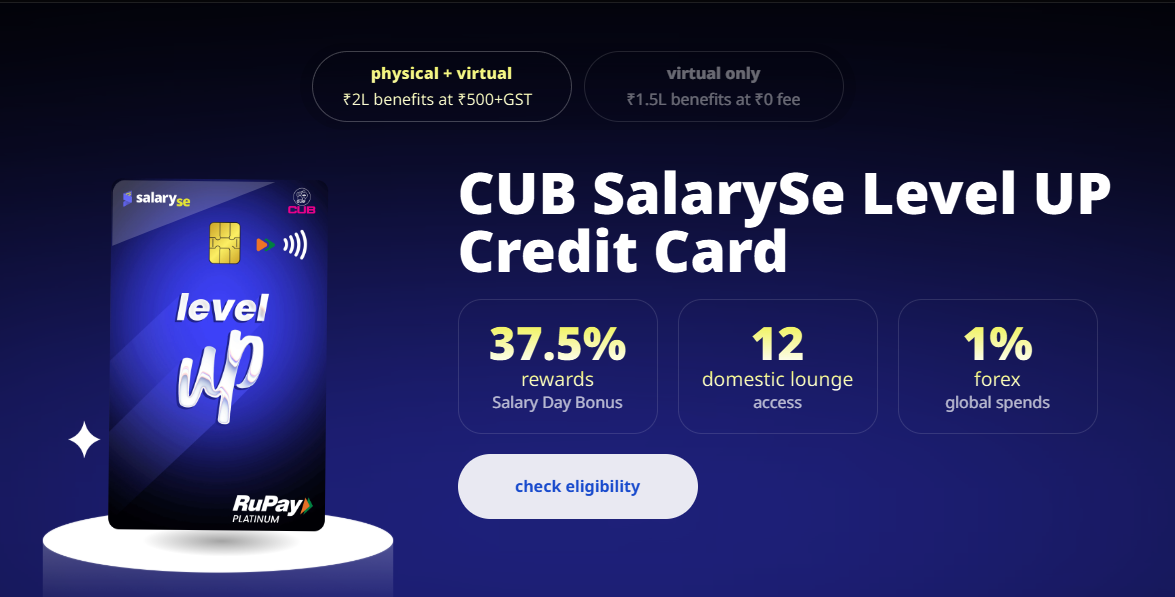
- CUB SalarySe Level UP Credit Card — issued by City Union Bank. Available as a physical card (₹500+GST fee) or a lifetime-free virtual RuPay card.
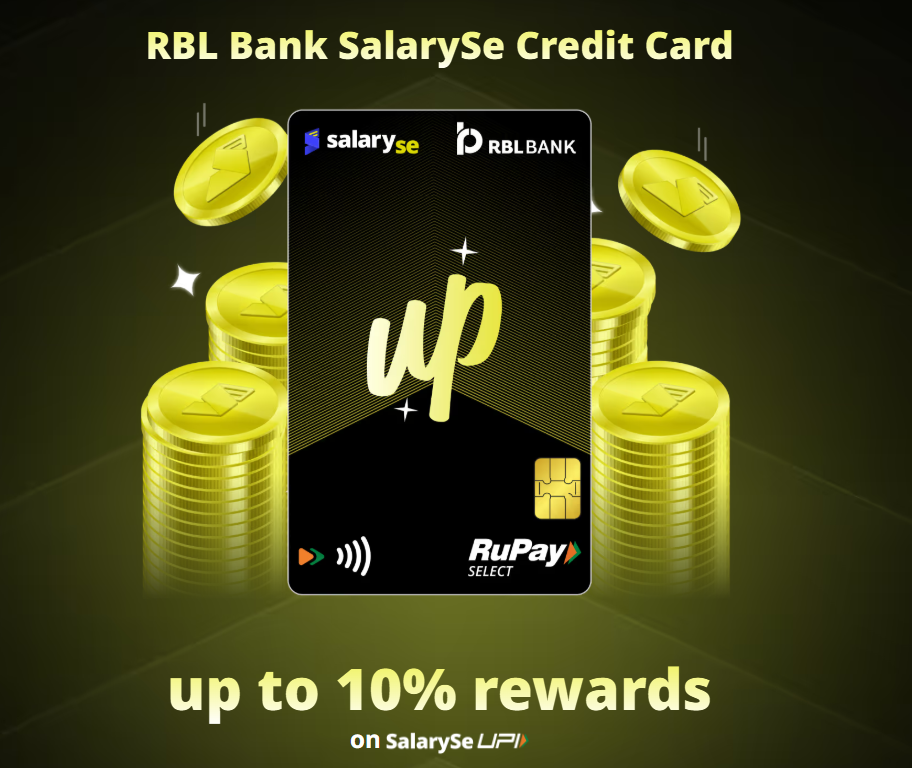
- RBL Bank SalarySe UP Credit Card — issued by RBL Bank. Physical card with ₹499+GST joining fee and ₹1,200 in welcome benefits.
I applied for and used both. Here’s what I found.
Salary Se Credit Card Review: The LevelUP Card Reward Structure in Real Life

Every Salary Se Credit Card review I’ve read either oversimplifies the reward tiers or just quotes the marketing copy. Let me break this down the way it actually works when you’re using the card day-to-day.
Salary Se Credit Card Review: The Salary Day Bonus Explained
On the 1st and last day of every month, UPI transactions made through the SalarySe app earn 25 Reward Points per ₹100 spent. That’s the headline feature.
The physical LevelUP card caps Salary Day earnings at 5,625 RP across both days. The free virtual card caps at 3,750 RP.
When I first read this in a Salary Se Credit Card review elsewhere, I assumed it was too limited to matter.
But here’s what I actually did: I moved my broadband bill, Zepto grocery order, electricity payment, and one big Swiggy order to the 1st of the month.
That single day of planned spending earned me more reward points than the entire rest of the month combined.
The key word is planned. You don’t earn more by spending more randomly — you earn more by timing your high-value spends.
That’s a fundamentally different kind of credit card behaviour, and once you understand it, the Salary Se Credit Card starts making a lot more sense.
Salary Se Credit Card Review: The Three-Tier Everyday Rewards
Outside of Salary Days, this is how the Salary Se Credit Card reward tiers work:
- 1 RP per ₹100 — on UPI payments made via PhonePe, GPay, Paytm, or any app other than SalarySe. This is intentionally low. The card is designed to pull your UPI habit onto their platform.
- 5 RP per ₹100 — when your monthly spend via SalarySe UPI is below ₹20,000. Applies to SalarySe UPI, online checkout, and offline transactions.
- 10 RP per ₹100 — when your current month’s bill crosses ₹20,000. Every rupee above that threshold earns at 10x.
One thing no Salary Se Credit Card review I’ve seen explains clearly: the ₹20,000 threshold does not mean your entire bill jumps to 10x. Only the spend above ₹20K earns at 10x.
The spend below ₹20K earns at 5x. Know the difference — it affects how you should plan your monthly usage.
Salary Se Credit Card Review: The Lifetime Free Virtual Card
This is the most underrated part of any honest Salary Se Credit Card review. The virtual-only LevelUP card has:
- Zero joining fee
- Zero annual fee — forever
- Full reward structure (5x/10x/Salary Day Bonus)
- Slightly lower Salary Day Bonus cap (3,750 RP vs 5,625 RP)
- No lounge access
If you are new to credit cards, rebuilding your CIBIL score, or simply want to test the Salary Se Credit Card before committing to the physical version — start here.
There is genuinely no downside to applying for this card. No fee, no annual commitment, real rewards from day one.
Salary Se Credit Card Review: The RBL Bank UP Card
The RBL Bank SalarySe UP Credit Card is a different product from the LevelUP and deserves its own section in this Salary Se Credit Card review.
The welcome benefit structure is the strongest feature here: ₹500 cashback on your first ₹500 spend in month 1, ₹400 for completing 15 transactions of ₹500+ each, and ₹300 on hitting ₹30,000 total spend in the first 3 months. That’s ₹1,200 in benefits against a ₹499+GST joining fee — you’re net positive from day one.
The reward structure mirrors LevelUP: 10X Scoins on SalarySe UPI above ₹20K/month, 5X below, 1X on other platforms. The UP card adds brand-specific deals: 10% off EaseMyTrip, 8% off Zomato, 12% off Zepto, 10% off Paytm domestic flights.
My honest take after running this Salary Se Credit Card review for three months: the UP card works best as a companion to the LevelUP, not a standalone.
The Scoins model (5 Scoins = ₹1, gift cards only) is less flexible than direct cashback. But the welcome year economics are hard to beat.
Salary Se Credit Card Review: Fees and Real Cost of Ownership
| Feature | LevelUP Physical | LevelUP Virtual | UP Card (RBL) |
|---|---|---|---|
| Joining Fee | ₹500 + GST | ₹0 Forever | ₹499 + GST |
| Annual Fee | ₹500+GST (waived ₹2L spend) | ₹0 Forever | ₹500+GST (waived ₹2L spend) |
| Forex Markup | 1% | N/A | ~3.5% standard |
| Lounge Access | 12/year (₹10K prev. month) | None | None |
| Card Network | Visa/Mastercard | RuPay Virtual | Visa/Mastercard |
One number that deserves a dedicated mention in this Salary Se Credit Card review: the 1% forex markup on the LevelUP physical card.
Standard Indian credit cards charge 3.5% + GST on international spends. On ₹1 lakh of foreign transactions, that’s a ₹3,500 difference.
If you shop on international websites, travel abroad, or pay for SaaS subscriptions in USD, the LevelUP’s forex rate alone justifies the ₹500 annual fee many times over.
Salary Se Credit Card Review: How It Compares to Other Cards in India
No Salary Se Credit Card review is complete without an honest comparison to the alternatives.
vs IDFC FIRST Classic: IDFC is lifetime free with reasonable rewards but has no UPI credit linkage and no Salary Day mechanic. The Salary Se Credit Card wins decisively for UPI-heavy spenders.
vs Amazon Pay ICICI: Amazon Pay gives 5% back on Amazon and credits it directly to your statement — zero redemption friction. If you spend heavily on Amazon specifically, that simplicity is hard to beat. The Salary Se Credit Card wins on total reward potential across a broader spend mix.
vs OneCard/Slice: These fintech cards target the same demographic but don’t have the Salary Day Bonus or the established bank infrastructure of CUB and RBL behind the Salary Se Credit Card.
The honest limitation this Salary Se Credit Card review won’t hide: if you’re not willing to make SalarySe your primary UPI app, this card drops to 1 RP per ₹100 on most transactions. At that point, it’s one of the weakest cards in the market. The entire value proposition is built on SalarySe UPI adoption. Know that going in.
Salary Se Credit Card Review: Applying with Referral Code UULSQZMN
The application process for the Salary Se Credit Card is fully digital:
- Download the SalarySe app on Android or iOS
- Select your preferred card — LevelUP (CUB) or UP (RBL)
- Check eligibility — salaried professionals, typically ₹20,000+ monthly income
- Complete video KYC with Aadhaar and PAN
- Enter referral code UULSQZMN when prompted
- Virtual card issued instantly; physical card in 5–7 business days
My strong recommendation based on this Salary Se Credit Card review: start with the free virtual LevelUP. Use it for one billing cycle. Check if the rewards match your spending pattern. Then upgrade to the physical card if it makes sense.
Salary Se Credit Card Review: What Other Reviews Get Wrong
After reading every Salary Se Credit Card review I could find, here’s what most of them miss:
The Salary Day cap is absolute, not proportional. Once you hit 5,625 RP on salary days, additional transactions earn at the regular tier rate. Don’t try to front-load your entire month into those two days.
The ₹20K threshold follows your billing date, not January 1st. If your billing cycle starts on the 15th, your super-accelerated tier resets on the 15th. This catches people out every single month.
Switching back to GPay even once costs you. Every non-SalarySe UPI transaction earns 1 RP per ₹100 regardless of your billing tier. The Salary Se Credit Card reward system requires consistency on the UPI side.
RuPay virtual card limitations are real. The free virtual Salary Se Credit Card runs on RuPay. For domestic use — UPI, Indian e-commerce, Indian subscriptions – it works perfectly. For international payment gateways and some global SaaS platforms, RuPay can be rejected. Keep a Visa/Mastercard as backup for international spends.
Salary Se Credit Card Review: Who Should Apply?
Based on three months of real usage, here’s my final framework from this Salary Se Credit Card review:
Apply without hesitation if:
- You’re salaried with ₹15,000–₹50,000/month in UPI spends
- You’re willing to use SalarySe as your primary UPI app
- You want a lifetime-free credit card with genuine rewards
- You make international transactions and want a low forex markup card
Think carefully before applying if:
- You want direct cashback, not points or Scoins
- Most of your spending is offline, cash-based, or non-UPI
- You need round-the-clock customer support from an established bank
Best pairing strategy: Use the Salary Se Credit Card for all SalarySe UPI spends + international transactions. Pair it with Amazon Pay ICICI or SBI Cashback for non-UPI online purchases. This combination covers almost every spend category at a strong reward rate.
Useful External Resources
- SalarySe LevelUP Card — Official Page
- SalarySe UP Card — Official Page
- RBI Master Directions on Credit Cards
- Check Your Free CIBIL Score
- NPCI RuPay Network Overview
Internal Linking Suggestions
- Link to → Best UPI Credit Cards in India 2026
- Link to → How to Improve Your CIBIL Score Fast
- Link to → SalarySe InstaCash Salary Advance App Review
- Link to → Best Lifetime Free Credit Cards in India
- Link to → Best Cashback Credit Cards for Online Shopping in India
Conclusion
This Salary Se Credit Card review comes down to one honest verdict: if you’re a salaried professional spending ₹15,000–₹50,000 per month via UPI and you’re willing to make SalarySe your default UPI app, this card delivers genuinely competitive rewards that most traditional bank cards at this price point simply cannot match.
The Salary Day Bonus is real and earnable with basic planning. The lifetime-free virtual Salary Se Credit Card is one of the best no-risk credit card entry points in India right now. The 1% forex markup on the physical LevelUP card is a quietly excellent feature that deserves far more attention.
The trade-offs are real too — Scoins lack the flexibility of direct cashback, the reward structure demands SalarySe UPI loyalty, and the startup is still maturing on support infrastructure. But for the right user profile, this Salary Se Credit Card review lands at a clear yes.
Start with the free virtual card. Use referral code UULSQZMN when applying. Give it one billing cycle. The rewards will speak for themselves.
Frequently Asked Questions — Salary Se Credit Card Review
1. What makes the Salary Se Credit Card different from other credit cards? The Salary Se Credit Card is one of the only credit cards in India built around the UPI payment habit of salaried professionals. Its Salary Day Bonus rewards you with 25 RP per ₹100 on the 1st and last day of every month — days when salaried spending is typically highest. No other card in India currently offers this mechanic.
2. Is the Salary Se Credit Card genuinely free? The virtual LevelUP variant is lifetime free — zero joining fee, zero annual fee. The physical card’s ₹500+GST annual fee is waived on ₹2L+ annual spend. Most serious cardholders will comfortably cross that threshold.
3. How does the Salary Day Bonus work on the Salary Se Credit Card? On the 1st and last day of every month, UPI payments through the SalarySe app earn 25 RP per ₹100. The physical card caps this at 5,625 RP per month; the virtual card at 3,750 RP. Plan high-value payments on these days to maximise the benefit.
4. What is the SalarySe referral code? The referral code is UULSQZMN. Enter it during your Salary Se Credit Card application on the SalarySe app for referral benefits.
5. Are Salary Se Credit Card reward points worth redeeming? On the LevelUP card, 1 RP = ₹1 in statement credit — excellent value. On the UP card, 5 Scoins = ₹1 redeemable as gift cards (Amazon, Flipkart, Swiggy, Zomato). If these platforms match your lifestyle, the Salary Se Credit Card rewards translate to real savings.
6. Is the Salary Se Credit Card safe? Yes. The Salary Se Credit Card is issued by RBI-regulated banks — City Union Bank (LevelUP) and RBL Bank (UP card). All card operations fall under RBI’s standard credit card framework.
7. Does the Salary Se Credit Card offer lounge access? The physical LevelUP Salary Se Credit Card provides 12 domestic lounge visits per year (1 per month), conditional on spending ₹10,000 in the previous billing month. The virtual card and RBL UP card do not include lounge access.
8. What is the minimum income to apply for the Salary Se Credit Card? The Salary Se Credit Card targets formally employed salaried individuals. The typical minimum is ₹20,000–₹25,000 per month, though exact criteria are set by the issuing bank. Check eligibility in the SalarySe app directly.
Disclosure: This article contains referral code UULSQZMN. The author may receive a benefit if you apply using this code. All views are based on personal use and independent research.
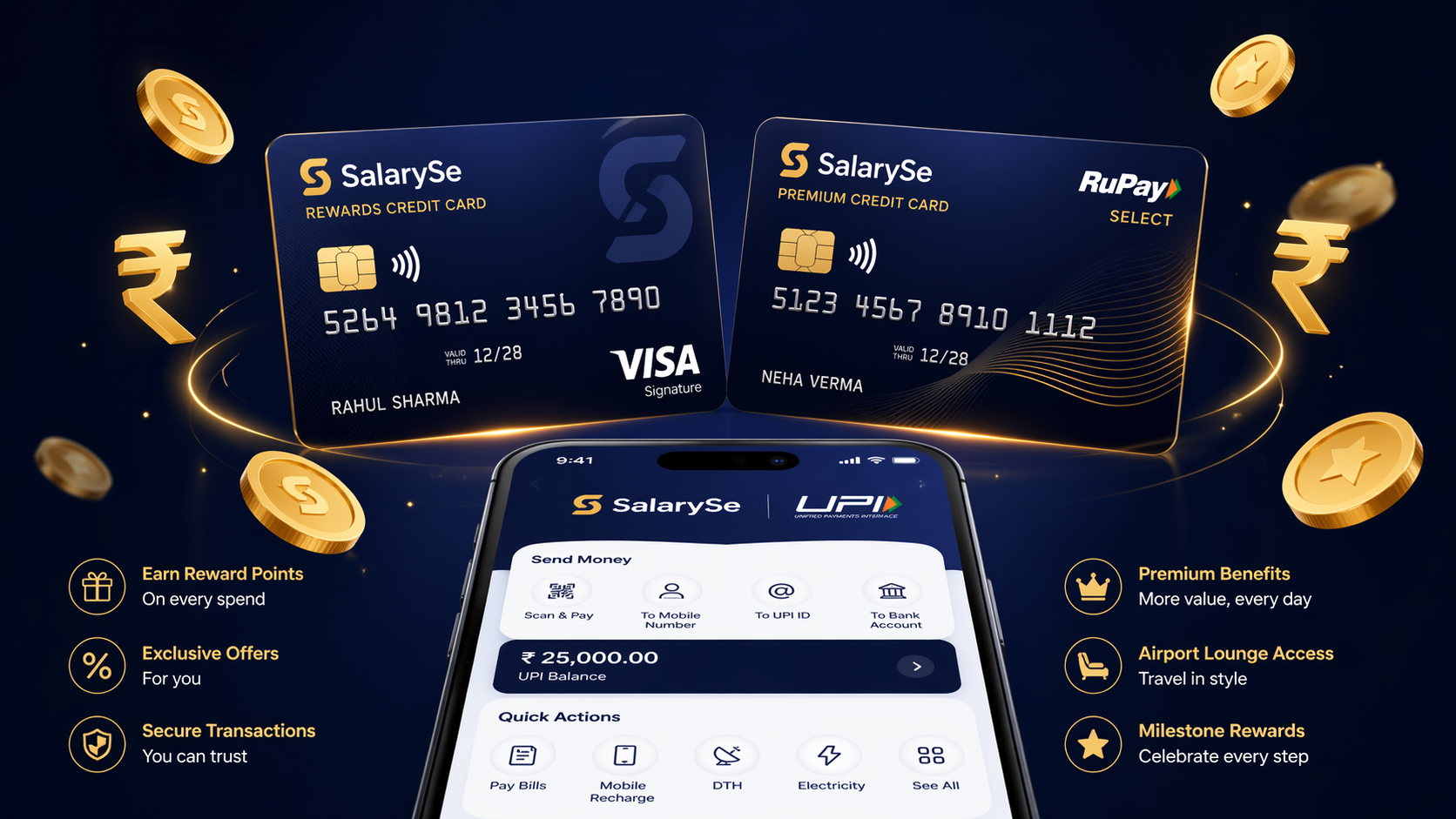
Featured Image Alt Text: Salary Se Credit Card Review — LevelUP and UP card shown on SalarySe app with UPI payment screen
Featured Image Prompt (AI generation): Dark navy background, two sleek credit cards side by side floating above a smartphone showing SalarySe UPI app, golden reward coins and rupee symbols around the cards, clean modern fintech visual, 16:9 banner format
- SalarySe LevelUP Card — Official Page
- SalarySe UP Card — Official Page
- RBI Master Directions on Credit Cards
- Check Your Free CIBIL Score
- NPCI RuPay Network Overview